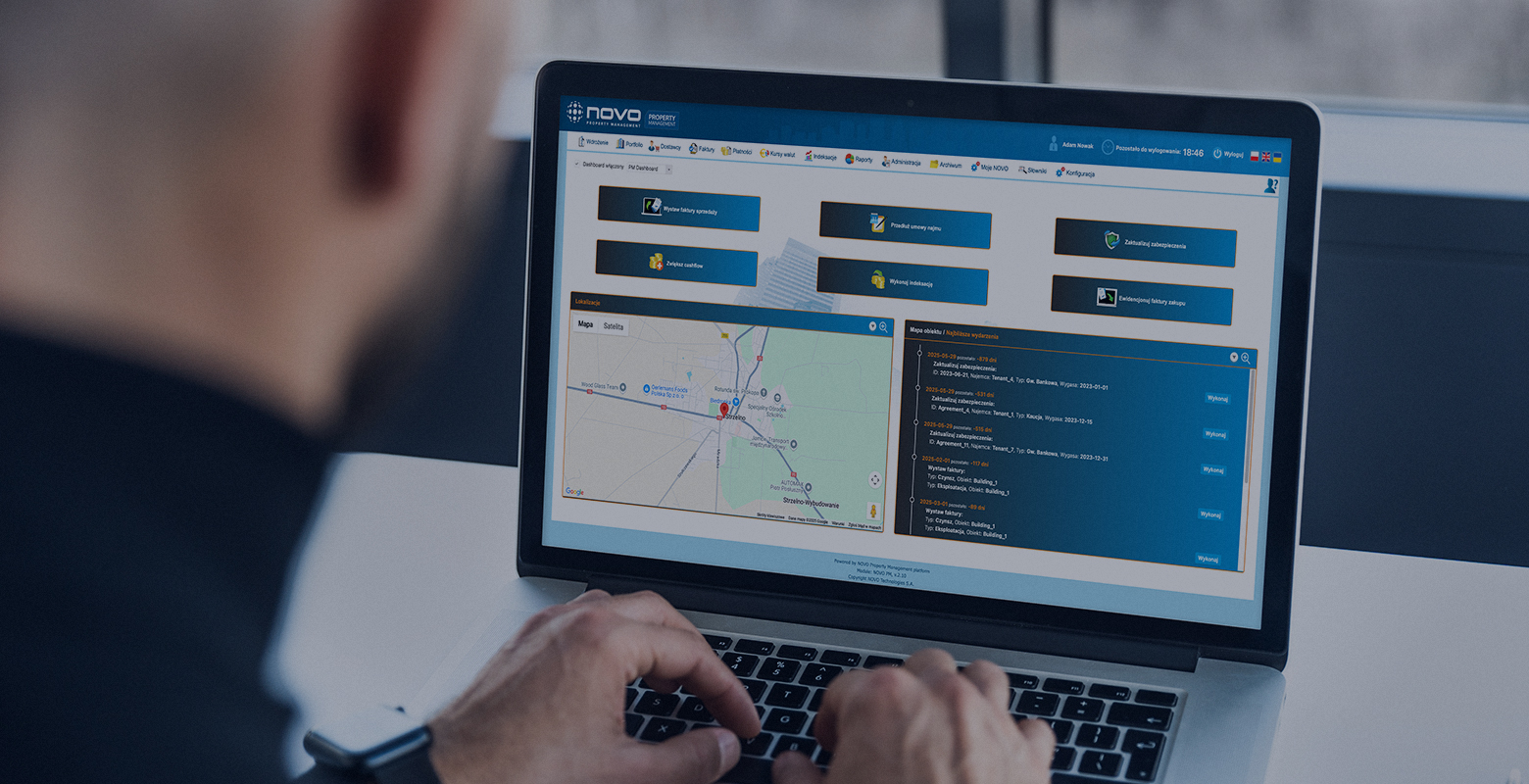
In the investment environment, the quality of operational and financial data is no longer an administrative issue. Today, it is one of the factors influencing the pace of transactions, the level of risk, and the perceived value of real estate assets.
When selling a property or an entire real estate portfolio, investors do not only analyze basic financial indicators. How data is stored, updated, and shared is becoming equally important. The architecture of the Asset & Property Management system is beginning to play a role that goes far beyond day-to-day management.
It is in this context that the concept of digital due diligence emerges.
What is digital due diligence in real estate?
Traditional due diligence focuses on the analysis of legal, technical, and financial documentation. Digital due diligence broadens this perspective to include the quality of the data environment and IT systems supporting asset management.
What is assessed
- the completeness of lease contracts data,
- the consistency of rent indexation and annexes,
- the transparency of financial and operational settlements,
- the history of tenant arrears,
- the availability of real-time investment reports.
It is not just a question of whether the data exists. The key is whether it is organized, up-to-date, and quickly verifiable. For large commercial portfolios, the quality of this layer can shorten the transaction process by weeks.
Operational data and real estate asset valuation
The value of commercial real estate is directly linked to its ability to generate stable income. Indicators such as NOI (Net Operating Income), vacancy rates, and lease structure form the basis of the valuation model.
If this data is scattered, updated manually, or inconsistent, the level of uncertainty on the investor’s side increases. Uncertainty translates into a higher discount on the price of the property in the valuation model.
What a system designed around the asset enables
- rent indexation schedules,
- expiring lease contracts and renewal options,
- revenue structure broken down by tenant segment,
- debt levels and tenant payment history.
In such a model, operational data does not require additional processing before presentation to the investor. It is a direct source of reports.
Centralization of information as a risk reduction factor
One of the most common problems in transaction processes is the dispersion of data and information. Some of the documentation is in the accounting system, some in spreadsheets, and some in local file repositories.
What dispersed environments increase the risk of
- misinterpretation of data,
- omission of annexes or changes to lease terms,
- inconsistencies between financial and operational reports and accounting.
The Asset & Property Management system, based on a central database, reduces this risk by standardizing information about buildings, contracts, and settlements. In the investment context, this means greater transparency and faster verification.
System architecture and readiness to sell a real estate portfolio
Organizations that treat the Asset & Property Management system as part of their investment infrastructure are able to maintain constant transaction readiness. This means the ability to generate a complete set of data for the investor’s needs virtually immediately, without lengthy reorganization projects.
Distributed vs centralized environment
| Area | Distributed data | Centralized Asset & Property Management system |
|---|---|---|
| Lease contracts | Local files and spreadsheets | Unified database |
| Indexing | Manual updates | Automatic mechanisms |
| NOI reports | Consolidation from multiple sources | Report based on system data |
| Change history | Limited visibility | Full audit trail |
This difference is not just about operational convenience. It affects the perceived quality of asset management.
Time as a value factor
In the real estate sales process, time has financial significance. Prolonged due diligence generates costs and increases market uncertainty.
A system that enables quick access to consistent data shortens the analysis process. This means less risk of price renegotiation at the final stage and greater control over the transaction schedule. In the investment environment, data transparency is becoming an element that builds trust.
The impact of data quality on relationships with financiers
Banks and financial institutions increasingly expect not only historical financial statements, but also access to current financial and operational data. An Asset & Property Management system that enables the generation of reports based on current contract data increases the credibility of the organization.
For funds operating in multiple markets, this supports relationships with financial partners and institutional investors.
Digital due diligence as part of a management strategy
In organizations where real estate is a key asset class, the IT system is no longer just an administrative support tool. It becomes an investment risk management tool.
Digital due diligence does not begin when a real estate asset is put up for sale. It is the result of a long-term approach to data centralization, process automation, and the integration of the operational and financial layers. The architecture of the Property Management system therefore affects not only day-to-day efficiency, but also the way the portfolio is perceived by the market.
Frequently asked questions
Does the Asset & Property Management system have a real impact on property valuation?
It directly affects the quality and reliability of operational and financial data, which form the basis of the valuation model. The greater the transparency and consistency of information, the lower the level of uncertainty on the part of the investor.
Does digital due diligence only apply to large funds?
It is most important in the case of large commercial portfolios, but growing investor requirements mean that the quality of operational and financial data is also becoming important in smaller structures.
Does data centralization shorten the transaction process?
Yes. Organized, up-to-date, and easily accessible data reduces the time needed to verify information and reduces the risk of inconsistencies.
Does the implementation of an Asset & Property Management system require a change in the accounting environment?
Modern platforms enable integration with existing accounting systems, allowing you to maintain your existing financial structure while streamlining the operational layer.